
By Joe Yu & Cosmo (AI Editor)
Here’s something most owners find out the hard way: Instagram’s own recommendation guidelines say content that “promotes or depicts cosmetic procedures” may be ineligible to be recommended to people who don’t follow you. The platform your medspa markets on treats your core content category as sensitive.
That single fact reframes the whole channel. It’s why “just post more Reels” is incomplete advice for a medspa, why paid distribution carries more of the load in aesthetics than owners expect, and why we push practices to run paid and organic as one system instead of two hobbies.
This guide covers that system: how the layers work together, what the math looks like when you run it with your own numbers, what Meta’s rules actually say in 2026, and the four places the system usually breaks.
This guide covers the paid + organic system; a companion organic-only deep-dive (content calendar, Instagram tactics) publishes separately and will be linked here.
Why paid and organic have to work together
A new patient who sees a Meta ad for your Sculptra campaign often makes one stop before booking: your Instagram profile. If it shows six posts from 2023 and a waiting-room photo, the ad’s job dies there. If it shows recent activity, provider personality, and results content, the profile finishes what the ad started. The ad buys attention; the profile closes the decision.
The reverse holds too, with the policy wrinkle from the opening: organic content can reach non-followers — Instagram recommends eligible public content across Reels, Explore, and suggested posts — but cosmetic-procedure content may be excluded from exactly those surfaces. For a medspa, organic reach to strangers may be policy-limited in a way most local businesses never have to think about. Paid distribution is how you reach cold audiences on purpose.
So the working model:
- Paid social handles discovery — cold reach at a cost you control and can measure.
- Organic handles conversion — the trust check every ad-clicker runs before booking.
- Retargeting closes the loop — paid, but aimed at people who already engaged and haven’t booked.
What the numbers look like (run this with your own inputs)
Honest framing first: we couldn’t find a neutral, published dataset of medspa ad performance. The figure you’ll see quoted around the industry — $30–$80 cost per lead — traces to a marketing agency’s published benchmarks: a vendor’s number, not a study. Use it as a starting hypothesis, nothing more.
What you can do is run the arithmetic with your own inputs. An example with deliberately round assumptions — every input here is a placeholder for your real number:
- $2,000/month spend at an assumed $50 CPL → 40 leads.
- At an assumed 20% lead-to-booked rate → 8 appointments.
- At an assumed $400 first-visit value → $3,200 first-visit revenue, or 1.6× the spend. (For calibration: AmSpa’s industry report puts average spend per medspa visit at $527 — across all visits, not first visits, which is why we assume lower here.)
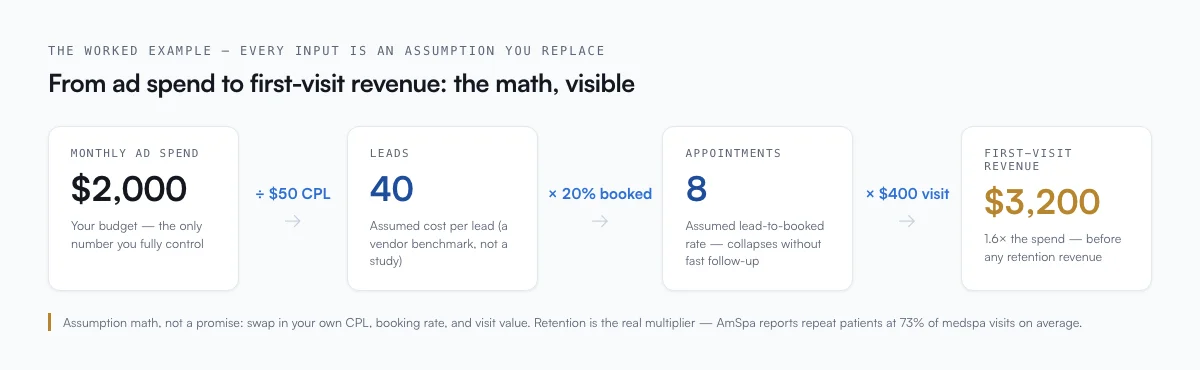
First-visit ROAS understates the channel because retention is the medspa business model — AmSpa’s same report puts repeat patients at 73% of visits on average. Value the lead stream on what a retained patient is worth to your practice over a year, not on visit one. And the whole model collapses at the follow-up step: 40 leads that sit in an inbox convert like zero leads. More on that below.
What Meta actually allows for before/after creative in 2026
Before/after imagery is the format aesthetic advertisers lean on hardest, and Meta regulates it tightly. What the platform’s own published policies say, as of July 2026:
- Meta’s Health and Wellness ad standards prohibit side-by-side before/after comparisons for specific treatment categories — Botox and dermal fillers as wrinkle/anti-aging treatments, and anti-aging transformations generally — regardless of whether the copy promises anything, while some general cosmetic before/afters remain allowed. The policy is treatment-specific, and it’s stricter than the “don’t guarantee results” folklore suggests.
- The same policy bars framing that implies a perfect body type or plays on negative self-perception, and requires cosmetic-procedure ads to be targeted 18+.
- Ad review is typically completed within 24 hours, and account-level restrictions are described as consequences of severe or repeated violations, with an appeal path. Not every rejected ad is a crisis; a pattern of them is.
Two practical notes from our side of the table: keep a library of creative that has cleared review and build variants from it rather than gambling a time-sensitive promo on brand-new creative; and treat patient imagery as a legal question before a platform question — if your practice is a HIPAA covered entity (most prescribing practices are), HHS guidance on filming and media means posting identifiable patient images requires a valid HIPAA authorization — a signed instrument, not a casual yes. And what makes it valid isn’t a matter of taste: 45 CFR § 164.508(c) spells out the required elements — a specific description of the images, who may use them and who may receive them, each marketing purpose, an expiration date or event, a dated signature, the written-revocation right, a statement that treatment can’t be conditioned on signing, and a redisclosure warning. If your consent form is missing any of those, it isn’t a HIPAA authorization — it’s a liability with a signature line.
Campaign structure: three audience tiers
A functional Meta setup for a medspa runs three campaign types at once (Meta’s targeting documentation covers the mechanics):
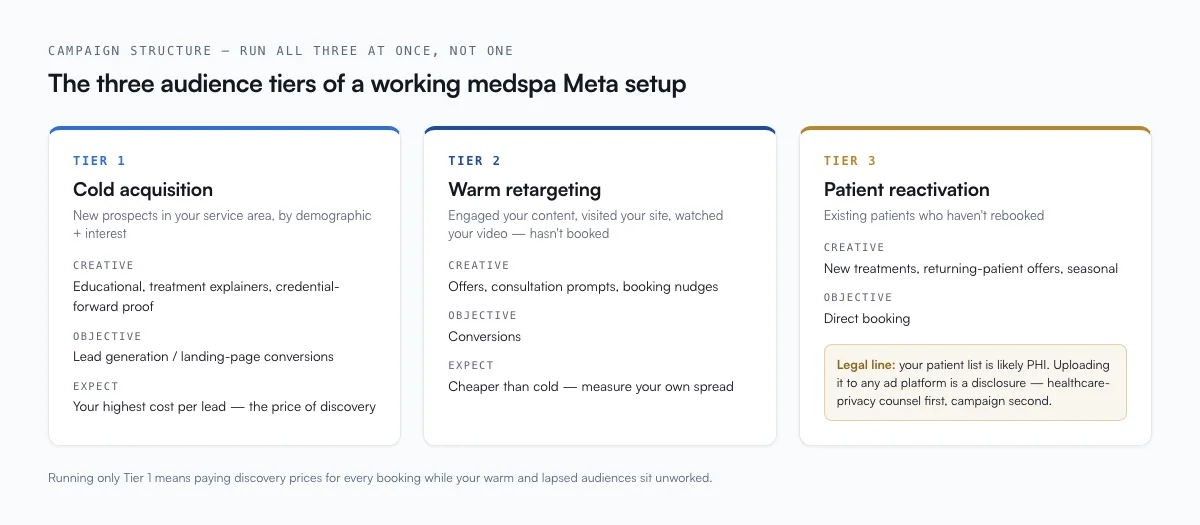
Tier 1 — Cold acquisition. New prospects in your service area by demographic and interest. Creative: educational, treatment explainers, credential-forward social proof. Expect your highest cost per lead here; that’s the price of discovery.
Tier 2 — Warm retargeting. People who engaged with your content, visited your site, or watched your videos but haven’t booked. Creative: offers and booking prompts. These audiences already know you; measure your own cold-vs-warm CPL spread rather than trusting anyone’s published ratio.
Tier 3 — Patient reactivation. This is where a hard legal line runs through standard marketing advice. Meta supports customer-list custom audiences, and every marketing guide will tell you to upload lapsed patients. But your patient list is likely protected health information: HHS treats most marketing uses of patient data as requiring authorization, with narrow exceptions — and whether a Custom Audience upload fits any exception is precisely the question for counsel, because the upload is a disclosure. Get a healthcare-privacy read on your specific list, consents, and state law before this tier exists. Plenty of practices do run it; the ones that do it safely did the legal work first.
The organic layer: one job
When an ad-clicker lands on your profile, she’s asking three things: is this provider credible, do people like me get results here, and what’s it actually like to go here. Your content mix answers those or doesn’t. Our working starting point — and it’s a starting point, not research: roughly 40% results content (with valid patient authorization, within platform policy), 40% provider voice and process, 20% offers. All results content and you look like a factory; all education and you look like an influencer, not a practice. Watch what your own audience saves and shares, then adjust.
On Reels: Meta built the format to reach new audiences, and for many local businesses it’s the organic-reach play. For medspas, remember the opening of this piece — procedural content may be recommendation-ineligible. Test video content in both flavors: procedure-adjacent (results, walkthroughs) and clearly non-procedural (team, space, Q&A), and let your reach numbers tell you where the ceiling is. Then run retargeting against your video viewers, which Meta supports as a custom audience.
The four places the system breaks
1. Lead response speed. Meta Lead Ads capture contact info inside the platform — the leads arrive whether or not anyone answers them. A Harvard Business Review analysis of 1.25 million online leads found contact attempts within the first hour were nearly 7× as likely to qualify the lead as attempts an hour later (an InsideSales executive co-authored it; their own research says odds drop eightfold after five minutes). General sales data, not medspa-specific — but if your average response time is “tomorrow morning,” this is your leak.
2. No landing page. In our experience, sending paid traffic to your Instagram profile or a generic contact page is the fastest way to waste clicks. Dedicated landing page, one call to action, zero-friction booking form.
3. Creative fatigue. The same ad shown to the same audience too many times stops working. There’s no universal week count — watch your frequency metric and rotate creative when performance decays, rather than setting a campaign live and forgetting it.
4. No attribution. If you can’t say which bookings came from which campaign, you’re budgeting on gut feel. Minimum viable version: UTM parameters on every link, plus asking every new patient how they found you at intake.
The honest summary
Medspa social works as a system: paid buys the reach that policy caps for organic, organic closes the trust decision, retargeting catches the undecided, and a fast follow-up process turns inquiries into appointments. The version of “paid social doesn’t work” we hear most often decodes to: no landing page, slow follow-up, no retargeting. That’s a systems problem, and systems problems are fixable.
Three things to do this week:
- Time-stamp your last ten inquiries against your first response. If the median is over an hour, fix that before touching ad spend.
- Open your Instagram profile as a stranger would. Would you book? If not, fix the profile before buying traffic to it.
- Add UTM parameters to every link in every active campaign, and add “how did you find us?” to intake.
Two free live tools to pressure-test your own numbers: the Treatment ROI Calculator and the Practice Efficiency Audit. If you want an audit of what your current paid setup costs versus returns, talk to us. (Companion guides on organic strategy, full-channel marketing, and the Automated Medspa series link here as each publishes.)
Where these numbers come from
The platform rules above link to Meta’s own policy pages, the legal cautions to HHS, and the studies to their original publishers. None of it is medspa-exclusive data, and we’ve said so wherever that matters. What we couldn’t source, we left out — the advice is ours and reads that way. One standing caution: platform policy moves fast. These links were checked in July 2026; click through before you build a campaign on any of them.
Joe Yu is the founder of Cosmedi Solutions — the business behind the beauty. Cosmo is an AI editor trained on medspa practice-management research.