
By Joe Yu & Cosmo (AI Editor)
Try to compare the five platforms medspa owners shortlist most often and you hit a wall in the first ten minutes: they don’t even price the same way. Boulevard publishes per-location tiers. Zenoti quotes custom. Moxie has no fixed monthly fee at all — it prices on performance. You cannot line these up on a spreadsheet and pick the cheapest, because “cheapest” isn’t a column they share.
That’s the honest starting point for this category. The spec-sheet comparison most owners attempt is the wrong tool.
This guide won’t tell you which platform is best. The right answer depends on your practice. What it will do: explain what the category actually covers, give you a fair current read on the five platforms owners ask about, and — the part vendor sales decks skip — spell out what no scheduling platform will fix on its own.
The structure of this piece: what the software actually manages → the five platforms → the three questions that determine fit → what software won’t fix → where an AI layer sits.
What Does Medspa Software Actually Manage?
“Medspa software” is shorthand for a stack of four functions. The major platforms bundle versions of them (Moxie’s product page is a representative example, listing scheduling, client records, billing, and marketing as the core set):
Scheduling and booking. Online booking, provider calendars, room and resource allocation, cancellation management. This is where your no-show problem lives.
Clinical records (EMR). Intake, consent forms, treatment notes, before/after photos, prescription handling where applicable. Zenoti’s clinical feature set is a representative example of what this layer covers. One caution an attorney would give you: the software being “HIPAA-compliant” does not make your practice compliant — per HHS guidance on cloud services, that depends on your BAA, configuration, and how staff actually use it.
Point of sale and membership billing. Retail, packages, recurring memberships, split payments.
CRM and marketing. Client profiles, communication history, recall sequences, lapsed-client campaigns.
The trap we see over and over: the same four functions show up on the feature pages, at very different quality levels underneath. A platform with a beautiful booking flow can have thin treatment charting. The feature checklist won’t tell you which is which. A demo with your own workflows will.
The Five Platforms Owners Keep Asking About
These are the five that keep coming up in our own conversations with practices. Each name links to the vendor’s site, and the screenshots are their homepages as of July 2026 — so you can see who you’d be dealing with without leaving this page. Pricing below is what each vendor publishes — where they publish anything. Confirm before you sign; three of the five won’t give you a number without a call.
Boulevard
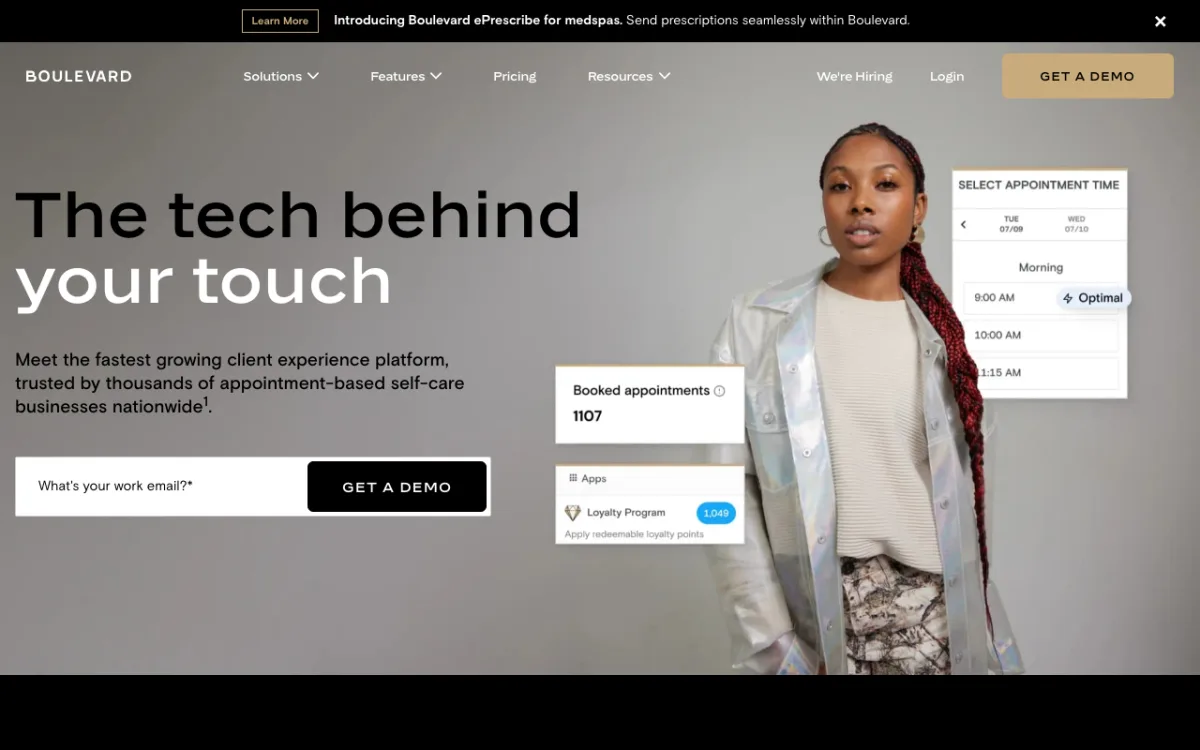
The pitch: client experience. The booking flow and checkout are the product’s center of gravity, and checkout includes a prebooking step — staff can book the next visit before payment completes, which is where rebooking is actually won.
The honest caveat: Boulevard grew up in salons and spas. It has since shipped a real medspa suite — SOAP notes, custom forms and charts, photo markup, provider sign-off — so the old “not built for injectors” reputation is out of date. Whether its charting depth matches a dedicated med-aesthetic platform for your treatment mix is a demo question, not a settled fact.
Pricing: published per-location tiers; normal rates of $176 / $293 / $410 per month, with promotional pricing below that at the time of writing.
Owner read: strongest candidate when booking conversion and rebooking rate are the metrics you’re trying to move.
Zenoti

The pitch: multi-location scale. Centralized reporting, staff management, and pricing control across sites is documented core functionality, and it’s the reason enterprise groups end up here.
The honest caveat: implementation is a project. Zenoti’s own published guidance puts onboarding at four to twelve weeks depending on complexity. Budget real staff time for it.
Pricing: custom-quoted only. No public rates.
Owner read: the pitch centers multi-location groups. A single-location practice should make Zenoti prove why the overhead is worth it.
Jane
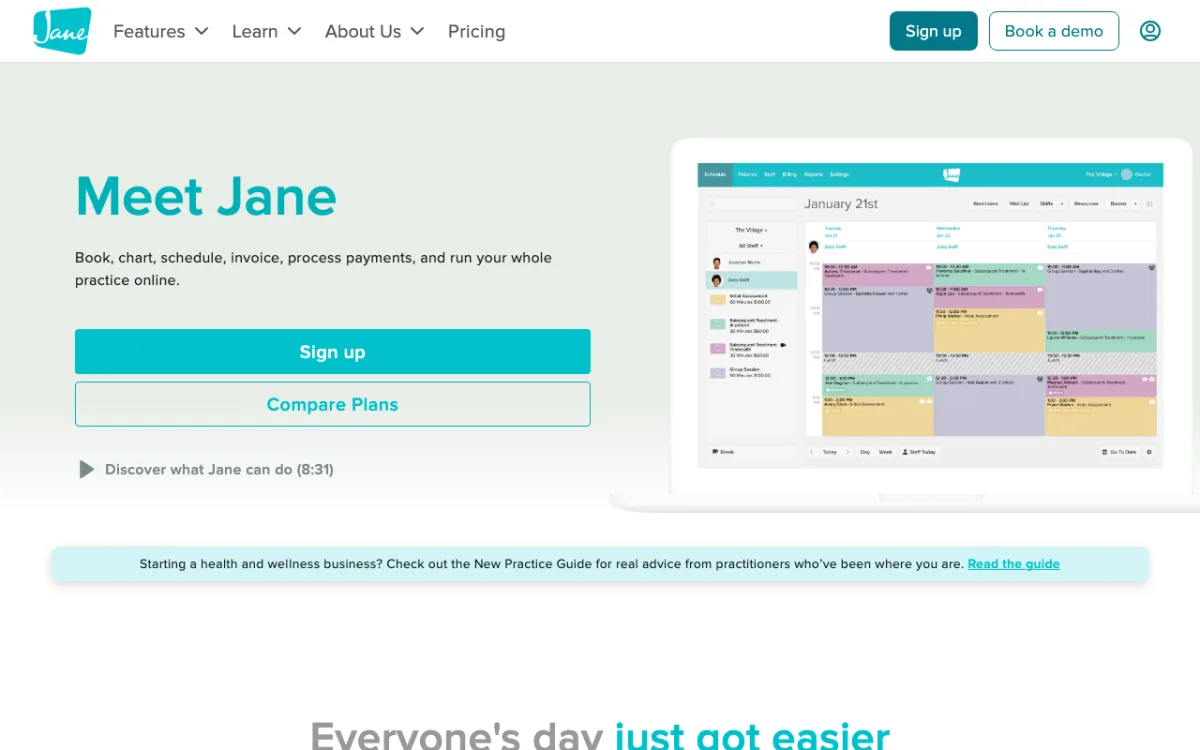
The pitch: clinical documentation. Jane came out of the practitioner world — charting templates, consent libraries, and customizable clinical documentation are the product’s roots, with HIPAA and PIPEDA compliance built in.
The honest caveat: marketing automation is not the core product. Jane documents retention features and a bidirectional Mailchimp integration for deeper email segmentation; it also states it has no open API, which matters if you plan to wire custom tools into your stack later.
Pricing: published base plans at $54, $79, and $99 per month, with per-practitioner and add-on charges calculated on top. The lowest published entry price on this list — though most of the list doesn’t publish comparable rates at all.
Owner read: the pick when clinical documentation is your primary compliance concern and you’ll accept adding a marketing layer separately.
Moxie

The pitch: built specifically for medspas — consent workflows, chart templates, and before/after photo tools are native, not adapted from a salon product.
The honest caveat: it’s young. The company launched in 2022. Ask hard questions in the demo about support response times and the specific integrations you need — and if a GLP-1 program matters to you, make them show you that workflow rather than taking the category’s word for it.
Pricing: no fixed monthly fee. Moxie describes its pricing as performance-based; make them walk you through exactly how the cost is computed at your volume, and model it against a flat-fee quote before deciding which structure you prefer.
Owner read: worth evaluating if you want a platform that speaks med-aesthetic natively and you’re comfortable being an early-ish adopter.
Envision / PatientNow
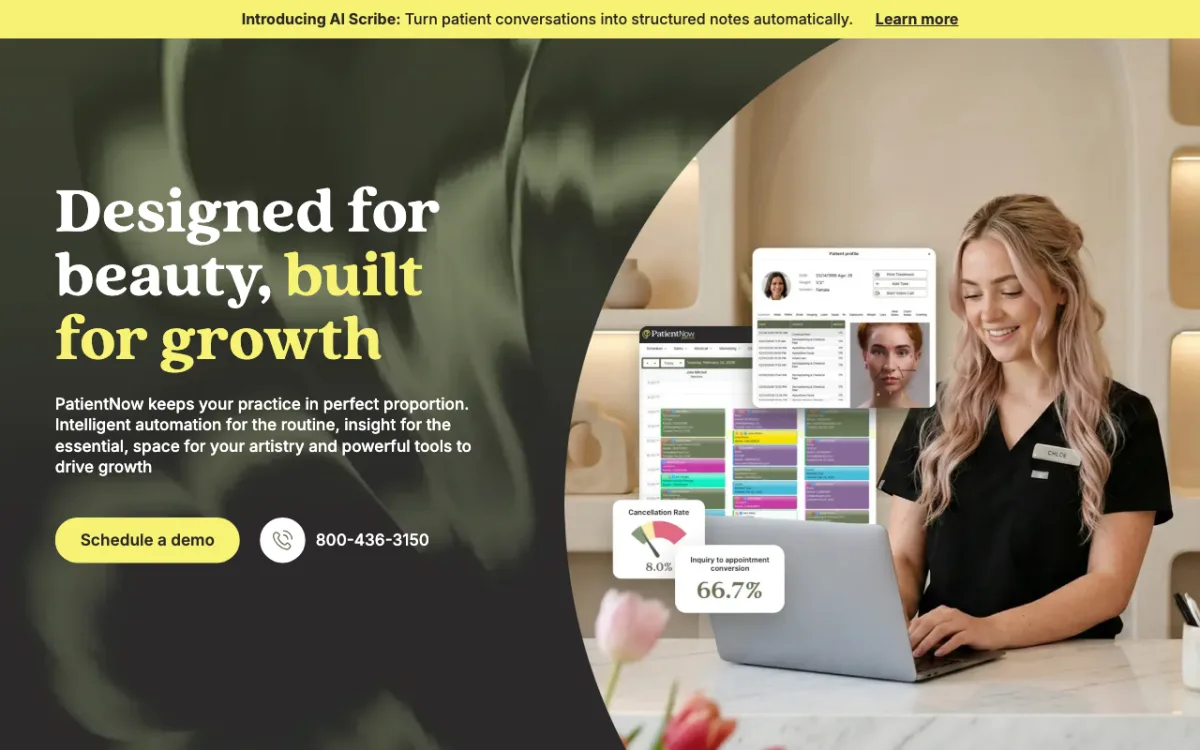
The pitch: the long-tenured med-aesthetic feature set, with injectable inventory tracking as a signature capability. If per-vial accountability is non-negotiable for you, this is the lineage to test — and make per-vial tracking your demo test case rather than taking the brochure’s word.
The honest caveat: the product line is being brought under the PatientNow brand (existing Envision users can keep the program, per the vendor), so ask directly what you’re buying today and what the migration path is. We couldn’t find current published pricing — get the fee schedule in writing.
Owner read: evaluate it as PatientNow, with inventory control as your test case.
The Three Questions That Actually Determine Fit
1. What took the most money or time from you last month?
Not in theory. Look at last month. If it was no-shows, weight the scheduling and reminder layer. If it was a consent-form scare or messy treatment notes, weight the EMR (Jane and the Envision/PatientNow lineage are the documentation-first candidates on this list). If it was empty chairs from clients who never came back, weight CRM — and read the next section first, because this is the layer where software alone underdelivers.
2. What will your staff actually use?
The best software your team abandons in month two loses to the mediocre software they run every day. Run a two-week trial with the people who will live in it daily, not just the owner. Their friction list is worth more than any review site.
3. What is the 12-month total cost of ownership?
The subscription is often not the biggest line. Add payment processing — Square’s published rates of 2.6%–2.9% plus a per-transaction fee are representative of the category; on $60,000 a month that’s roughly $1,600–$1,800 in processing before the software fee. Add per-SMS charges (Boulevard and Zenoti both bill messaging by usage), integration costs, and the staff hours month one absorbs. A $100/month sticker difference can vanish inside a 0.2-point processing spread.
What Medspa Software Will Not Fix
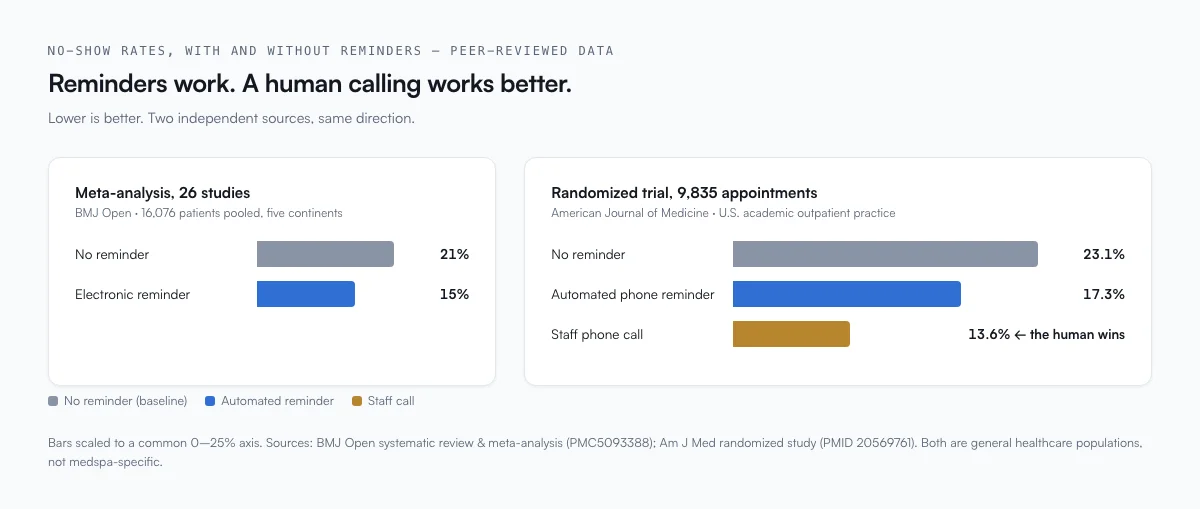
Automated appointment reminders are table stakes across this category, and they genuinely work: a 26-study healthcare meta-analysis found electronic reminders cut pooled no-show rates from 21% to 15%. But here’s the detail vendors skip — in a randomized trial of 9,835 appointments, a staff phone call beat the automated reminder (13.6% no-shows vs 17.3%). The human touch outperformed the feature. And rebooking is won or lost in the moment after checkout, face to face — a front-desk protocol, not a toggle. Software triggers the text. It doesn’t have the conversation.
Lead response has the same shape. Your platform logs the 11:30 p.m. inquiry. Someone — or something — still has to answer it. The numbers on response speed are stark: a Harvard Business Review analysis of 1.25 million online leads found businesses that attempted contact within an hour were nearly 7× as likely to qualify the lead as those who waited another hour — and 60× as likely as those who waited a day (disclosure: an InsideSales executive co-authored it, and InsideSales’ own research reports an eightfold drop after five minutes). None of it is medspa-specific data, but every owner who’s watched a hot inquiry go cold overnight knows the direction is right.
Worth saying plainly: the platforms know this too. Zenoti advertises an AI receptionist; PatientNow sells an AI response product called Recura. The gap is closing at the feature-checkbox level. The open question — for their tools and anyone’s — is response quality, and whether the automation is actually configured and running in your practice. Review requests are a small example: Boulevard lets you time them anywhere from one hour to a week after checkout, but a request that fires generic copy at a default time performs like what it is.
Software handles the transaction layer. Turning inquiries into bookings, visits into rebookings, and happy clients into reviews takes a layer of orchestration on top — configured, personalized, and watched.
Where the AI Layer Fits
How big is the gap it closes? Vendor call-tracking datasets — take them as industry benchmarks, not guarantees — put healthcare’s missed-call rate at 32%, the worst of six industries measured, and find only 54% of inbound healthcare callers ever reach a person. Roughly a third to a half of the demand your marketing generates can die at the phone.
That orchestration layer is what we build at Cosmedi. Not a replacement for the platforms above — an automation layer that sits on top of whichever one you run: answering the after-hours inquiry, timing the follow-up, escalating the edge cases to a human.
If you want to gauge whether that layer is your bottleneck before talking to anyone: check your rebooking rate, your average inquiry response time, and whether your review requests go out at all. If those numbers embarrass you, a platform switch probably won’t fix them. The data on switchers backs this up: in an AAFP survey of 305 physicians who had switched EHRs, 81% called the time investment a moderate or major challenge — and only 28% felt the new system actually improved productivity, against 49% who said it didn’t. (And if you’re wondering what a switch costs in dollars: the peer-reviewed literature supports no standard figure — any confident “$50K–$150K” range you read online is commercial conjecture. The real cost is the time and the disruption, which is exactly what the survey measured.)
The Bottom Line
Pick the platform that matches your primary pain point, trial it with the staff who’ll use it, and price the full 12-month cost including processing. Then solve what the software can’t: the conversations, the timing, the follow-through. Chasing that second problem with a platform switch is how owners end up migrating twice and fixing nothing.
Three things to do this week:
- Pull last month’s numbers for no-shows, rebooking rate, and average inquiry response time. Pick your platform priority from what they say.
- Book demos with two platforms from this list — one incumbent, one med-aesthetic-native — and bring your three ugliest real workflows to both.
- Ask each vendor for their current pricing in writing, including processing rates and per-SMS costs. Two of the five won’t have a public number; make them give you one anyway.
Where these numbers come from
Every number in this guide links to its source — the vendor’s own pricing page, the study itself, the regulation. When we couldn’t trace a claim to a real source, we cut it instead of keeping it. The judgments and recommendations are ours, from our own conversations with practices, and written as ours. Vendor pricing and features were checked in July 2026 and will drift; get current numbers in writing before you sign. As we gather first-hand client data we’ll fold it in the same way — sourced, or not included.
Next: run your numbers through the Treatment ROI Calculator — the same math this guide describes, interactive.
Cosmedi Solutions — the business behind the beauty.